
 EN
EN
 AR
AR
 HR
HR
 DA
DA
 NL
NL
 FI
FI
 FR
FR
 DE
DE
 EL
EL
 HI
HI
 IT
IT
 JA
JA
 KO
KO
 NO
NO
 PL
PL
 PT
PT
 RO
RO
 RU
RU
 ES
ES
 SV
SV
 TL
TL
 IW
IW
 ID
ID
 LT
LT
 SR
SR
 VI
VI
 SQ
SQ
 HU
HU
 TH
TH
 TR
TR
 AF
AF
 MS
MS
 GA
GA
 BN
BN
 HA
HA
 IG
IG
 MR
MR
 NE
NE
 YO
YO
 MY
MY
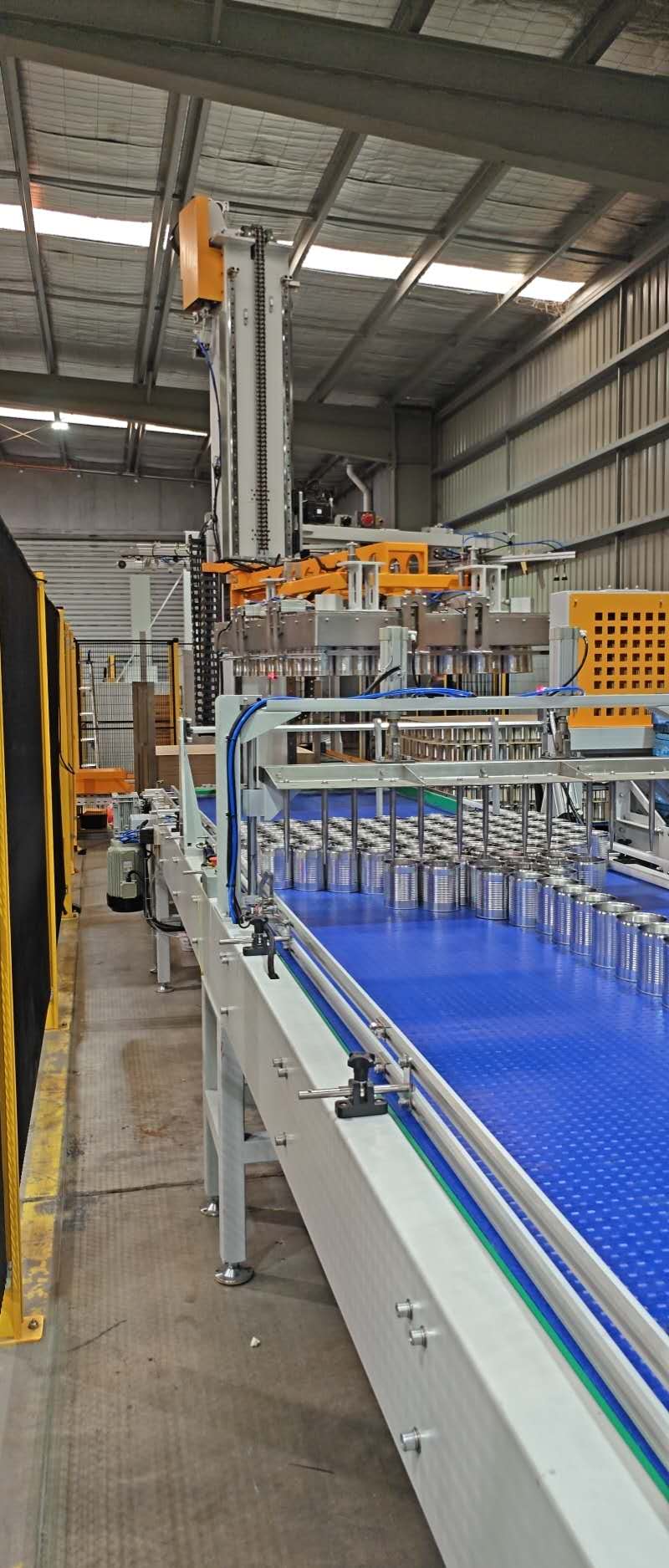
What is a Low Level Palletizer?
A low level palletizer is a palletizing machine that operates close to ground level.
Products enter the machine at a relatively low height, making the system easier to install and maintain.
In can manufacturing plants, low level palletizers are often used for empty tinplate cans because they offer reliable operation and require less building height.
Many manufacturers prefer this design because it is simple, compact, and highly efficient.
A low level palletizer can easily integrate with a can conveyor system and other end-of-line automation equipment.
What is a High Level Palletizer?
A high level palletizer operates at a higher elevation.
Products are lifted to the top of the machine before being arranged into layers and placed onto pallets.
This design is commonly used in high-capacity production environments where continuous operation and large production volumes are required.
Because products enter the machine at a higher point, the palletizer can often handle more complex stacking patterns and larger throughput requirements.
Many large can manufacturing plants choose a high level palletizer when production output is exceptionally high.
Key Differences Between Low Level and High Level Palletizers
Although both systems perform the same basic function, there are several important differences.
Installation Height
One of the biggest differences is the required building height.
A low level palletizer is ideal for factories with limited ceiling space.
A high level palletizer typically requires a taller building because products must travel upward before palletizing.
If your facility has height restrictions, a low level system is often the better choice.
Production Capacity
For medium-speed can production lines, low level palletizers can provide excellent performance.
For extremely high-speed production environments, high level palletizers may offer additional capacity advantages.
However, modern low level palletizers have become increasingly efficient and can handle production speeds that were previously only possible with high level systems.
Maintenance Accessibility
Many factory managers appreciate the accessibility of a low level palletizer.
Since major components are closer to the ground, routine maintenance and inspections are generally easier.
A high level palletizer may require elevated access platforms for certain maintenance tasks.
Initial Investment
In many cases, a low level palletizer requires a lower overall installation investment.
Because it often requires less structural modification and less building height, implementation costs can be reduced.
This makes it particularly attractive for manufacturers upgrading existing facilities.
Why Many Can Makers Prefer Low Level Palletizers
In recent years, many can manufacturers have increasingly selected low level palletizer systems.
There are several reasons for this trend.
First, modern low level palletizers offer excellent performance for most can production lines.
Second, they are easier to install in existing factories.
Third, maintenance is typically simpler and more convenient.
For empty can palletizing applications, low level magnetic palletizers have become especially popular because they provide stable handling while minimizing the risk of can damage.
If you would like to learn more about conveyor integration, you may also be interested in our article on can conveyor system solutions for can manufacturing plants.
When a High Level Palletizer Makes Sense
Although low level palletizers are widely used, high level palletizers remain an excellent solution in certain situations.
A high level palletizer may be the better choice when:
- Production speeds are extremely high
- Factory space is not limited
- Long-term expansion is planned
- Complex stacking patterns are required
- Continuous large-scale production is the priority
Many large beverage can manufacturers continue to use high level palletizing systems because of their proven performance in high-output environments.
Automation Trends in the Can Industry
The global can manufacturing industry continues to move toward higher levels of automation.
According to the Can Manufacturers Institute (CMI), can makers are investing heavily in technologies that improve efficiency, sustainability, and workplace safety.
Similarly, PMMI reports continued growth in automated packaging and palletizing systems across manufacturing industries.
As labor costs rise and production demands increase, automation is becoming a necessity rather than an option.
This is one reason why both low level palletizer and high level palletizer systems continue to see strong demand worldwide.
Hubei Baoli's Palletizing Solutions for Can Manufacturing Plants
At Hubei Baoli Technology Co., Ltd., we specialize in automation equipment designed specifically for the tinplate can industry.
Our palletizing solutions include:
- Low level magnetic palletizers
- High level magnetic palletizers
- Rotary palletizers
- Robotic palletizers
- Full automatic palletizer for can making line systems
These systems can be integrated with:
- Can conveyor systems
- Automatic strapping machines
- Fully automatic stretch wrapping machines
- Robotic handling systems
to create a complete can factory automation solution.
If you are evaluating automation upgrades, you may also find these resources helpful:
Why Modern Can Factories Need Automation
Introduction to 3-Piece Can Production Lines
Which Palletizer is Better?
There is no universal answer because every factory has different requirements.
For many can manufacturers, a low level palletizer provides the best balance of performance, installation flexibility, maintenance convenience, and investment cost.
For very high-capacity facilities with sufficient building height, a high level palletizer may offer additional advantages.
The best solution depends on:
- Production speed
- Factory layout
- Budget
- Future expansion plans
- Automation objectives
A detailed evaluation of your production line is the best way to determine the most suitable system.
Low Level and High Level Palletizers for Can Production Lines
In beverage and food can manufacturing plants, palletizing is the final important process after can conveying and packaging.
For empty can production lines, the palletizer needs to handle high-speed continuous production while maintaining stable pallet patterns.
Hubei Baoli provides:
- Low level magnetic palletizer for empty cans
- High level magnetic palletizer
- Robotic palletizing system
- Customized palletizing solutions
Low level palletizers are suitable for medium-speed can production lines where factory height is limited.
High level palletizers are preferred for high-speed production lines because they provide higher efficiency and better integration with elevated conveyor systems.
Conclusion
Both low level palletizer and high level palletizer systems play an important role in modern can manufacturing plants.
The right choice depends on your production requirements and long-term business goals.
For most tinplate can manufacturers, selecting the appropriate palletizing solution can reduce labor costs, improve pallet quality, minimize product damage, and increase overall efficiency.
At Hubei Baoli Technology Co., Ltd., we provide customized palletizing solutions for can makers worldwide. Whether you need a low level palletizer, a high level palletizer, or a complete automation system for your can production line, our team can help you design the most effective solution for your factory.
Frequently Asked Questions
What is a low level palletizer?
A low level palletizer is an automatic palletizing machine that receives products at floor level and stacks products onto pallets. It is suitable for factories requiring simple installation, easy maintenance and medium-speed production.
What is the difference between low level and high level palletizer?
The main difference is the product feeding height. Low level palletizers work with floor-level conveyors, while high level palletizers use elevated conveyor systems and are usually designed for higher-speed production lines.
Which palletizer is better for can production lines?
For empty can production lines, the choice depends on production speed and factory layout. High level palletizers are suitable for high-speed lines, while low level palletizers are suitable for factories with limited space or lower production capacity.
Can a palletizer be customized for different can sizes?
Yes. Automatic palletizing systems can be customized according to can diameter, height, pallet size, production speed and factory layout.
please view our palletizer working videa from our youtube channel.
https://youtube.com/shorts/tAIY6T4NIEY?is=LQ8GnRUsurq0GlBD
Table of Contents
- What is a Low Level Palletizer?
- What is a High Level Palletizer?
- Key Differences Between Low Level and High Level Palletizers
- Why Many Can Makers Prefer Low Level Palletizers
- When a High Level Palletizer Makes Sense
- Automation Trends in the Can Industry
- Hubei Baoli's Palletizing Solutions for Can Manufacturing Plants
- Which Palletizer is Better?
- Low Level and High Level Palletizers for Can Production Lines
- Conclusion
- Frequently Asked Questions