
 EN
EN
 AR
AR
 HR
HR
 DA
DA
 NL
NL
 FI
FI
 FR
FR
 DE
DE
 EL
EL
 HI
HI
 IT
IT
 JA
JA
 KO
KO
 NO
NO
 PL
PL
 PT
PT
 RO
RO
 RU
RU
 ES
ES
 SV
SV
 TL
TL
 IW
IW
 ID
ID
 LT
LT
 SR
SR
 VI
VI
 SQ
SQ
 HU
HU
 TH
TH
 TR
TR
 AF
AF
 MS
MS
 GA
GA
 BN
BN
 HA
HA
 IG
IG
 MR
MR
 NE
NE
 YO
YO
 MY
MY
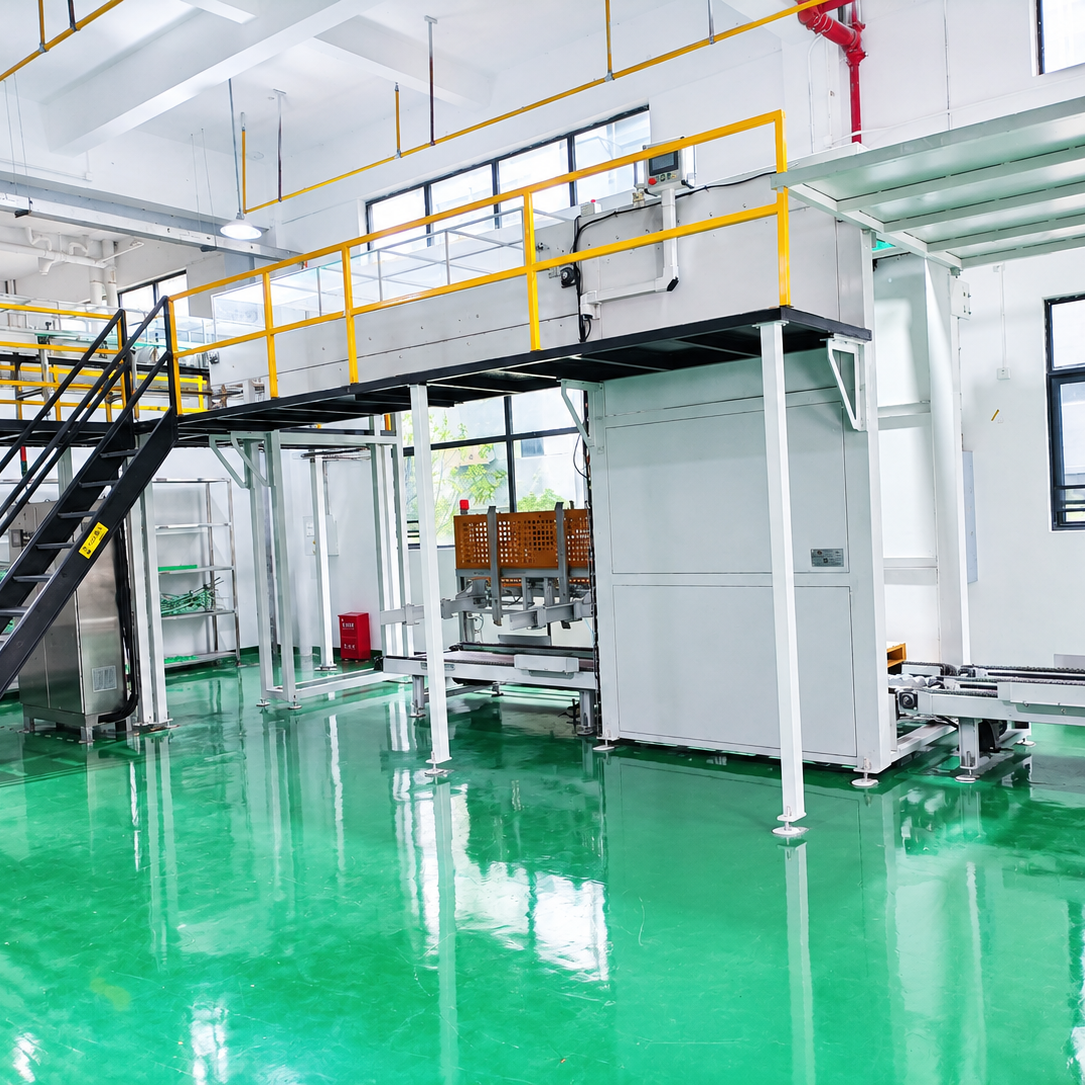
The Future of Automation in Asia — Palletizers and Depalletizers for Tomato Paste Cans
This article is not about whether to automate. It is about how to choose the right palletizer for tomato paste cans and, where it belongs upstream, the right depalletizer for canned food — without overpaying for a system your line does not need.
A tomato paste can plant in Shandong installed two new can-making lines last year. The welders run at 600 cans per minute. The ovens hold temperature. The fillers hit their target output on the first shift. And then the cans arrive at the end of the line.
For the last 40 meters, three workers per shift lift cases, stack them on pallets, and wrap the load by hand. During the summer canning season, the plant can barely hire enough people to fill those shifts. When someone calls out, the whole line throttles down — because the upstream machines keep running, and the cans pile up.
Why Tomato Paste Can Lines Are a Particular Automation Challenge
Filled tomato paste cans are a different physics problem from empty cans, and most generic palletizer specs get this wrong.
A filled 400g tomato can weighs roughly six times what an empty can does. A full pallet — say, 48 cases of 24 cans — carries close to a ton of product on a 1.1m × 1.1m footprint. That load squeezes the bottom layers. If the palletizer sets the top case with even a slight drop, the cans underneath buckle. The plant does not discover this until the customer opens the shipment.
End-of-line is also where injury rates spike. Case lifting, repeated in an 8-hour shift, is the classic ergonomic injury — and it is the station most likely to be short-staffed in a tight labor market.
Compare this with a beverage can line. Empty aluminum cans are light, thin, and cheap to replace if one tips. A tomato paste line cannot tolerate the same loss rate. A damaged case means product wasted, not just a dropped container.
The State of Automation in Asia's Canned Food Industry
Automation in Asia's food packaging sector has moved past the pilot stage. The Asia-Pacific packaging automation market reached roughly $30.3 billion in 2026 and is projected to grow to about $43.2 billion by 2031, at a 7.36% CAGR — one of the fastest-growing regions globally for this category. Within food packaging specifically, Asia-Pacific already accounts for the largest regional share of the global market, driven by rapid industrialization in China, India, and Southeast Asia.
Two forces are behind this, and neither is speculative. First, labor costs: food-sector labor costs have risen by roughly 15% over the past five years, a trend that hits high-volume, repetitive-motion stations — like palletizing — hardest, since these are exactly the roles that are both physically demanding and easiest to automate. Second, food-safety and export compliance: as more Asian manufacturers ship to markets with stricter hygiene and traceability requirements, manual handling at the end of the line becomes a harder standard to consistently meet.
End-of-line robotics — palletizing and case packing specifically — is where this shows up first. Analysts tracking the food packaging robotics market project Asia-Pacific to grow at roughly 14.2% CAGR through 2035, faster than any other region, with palletizing and case packing among the leading applications as plants look for automation that can run safely alongside existing manual stations rather than replacing an entire line at once.
For a tomato paste can plant specifically, this regional trend lines up with the physical reality on the floor: filled cans are heavy, stacking is repetitive, and it's usually the first station where a labor shortage or a safety incident forces the automation conversation — regardless of what the rest of the line looks like.
Palletizer vs. Depalletizer — What Each One Actually Solves
These two machines are often lumped together. They sit at opposite ends of the plant and solve opposite problems.
Where the Palletizer Sits in the Line
The palletizer is the last machine before the warehouse. It takes the filled, cased, and shrink-wrapped product, places it onto a wooden or plastic pallet in a stable layer pattern, and builds a load that a forklift can move without the stack shifting.
On a modern line, the palletizer does not run as an island. It talks to the case packer upstream, signals whether a pallet is full, and hands off to a stretch wrapper. This is what a properly integrated automatic palletizing system does — it absorbs the natural surge of upstream production and presents a steady load to logistics.
Where the Depalletizer Sits in the Line
The depalletizer is at the front of the plant. Its job is to take empty cans — stacked on incoming pallets from a can supplier — and feed them into the filling line one layer at a time.
This matters more than most buyers realize. If the depalletizer mis-feeds or jams, the filler starves. A line that runs 600 cans per minute loses ten minutes of output every time a worker has to climb onto a pallet and hand-feed the machine. A reliable depalletizer for metal cans is not glamorous, but it is the machine that decides whether the filler actually runs at rated speed.
What to Look for in a Palletizer or Depalletizer for Tomato Paste Cans
Four spec points separate a system that will hold up for a decade from one that spends its life troubleshooting.
Size the load, not the empty can. This is the most common buyer mistake. The palletizer's load cell and gripper are rated for the filled case weight, not the can weight. A 400g tomato case weighs in the same order of magnitude as a beverage case, but the pallet build-up and layer compression behave very differently. Ask the vendor to walk your pallet configuration, not just your can diameter.
Anti-tip and layer stability. Filled tomato paste cans have a lower center of gravity than empty beverage cans, but the bottom layers crush under load. Look for a layer-pattern algorithm that tapers the stack, and a clamp or fork that does not crush the outer case film when it picks.
PLC handshakes. The machine you buy today will need to talk to a case packer you install in three years. Siemens-based control architecture is the practical default — not because Siemens is inherently better, but because every integrator in Asia can service it, and the parts are available everywhere.
Multi-SKU flexibility. Tomato paste plants run 70g, 198g, 400g, and 850g cans on the same line in a year. If the palletizer needs a mechanic to change tooling for every SKU switch, it will spend most of the year idle on the SKU changeover. Quick-change end-of-arm tools are worth the price.
Baoli's Approach to Palletizing Automation
Hubei Baoli Technology Co., Ltd. builds auxiliary equipment for 3-piece can lines — conveyors, ovens, sheet feeding, and end-of-line packaging. That matters when you are buying a palletizer, because the palletizer is only as good as the conveyor feeding it.
We size the depalletizer, the conveyor section, and the palletizer together, around your actual line speed and pallet footprint. Electricals are Siemens PLC with Schneider components; the can-contact surfaces are SUS304. The machine is designed to integrate with whatever filler and case packer you already have, not to force you to replace them.
For plants that cannot stop the line for a full rebuild, we stage the install: a new depalletizer on one weekend, the palletizer six weeks later, commissioned around your production calendar.
What This Means for Plants Planning to Automate in the Next 1–2 Years
Two practical moves.
Automate the bottleneck first, not the whole line. In most tomato paste plants, palletizing has the shortest payback. It is where labor is expensive, injury risk is real, and the automation technology is mature. Spend the capex there before re-engineering the welder.
Choose a vendor who will service the line in five years, not just sell the machine today. A palletizer with a three-year warranty and a parts department 2,000 km away is not cheaper than a more expensive machine with local engineers. Ask the vendor for references in the same region before you ask for the quote.
Conclusion
Automation in Asia's canned food sector is not a future story. It is happening now, station by station, on the plant floor. For a tomato paste can line, the first station to automate is usually the one workers already hate.
If you are planning a line expansion or an end-of-line upgrade in the next 12 months, send us your can spec, pallet size, and current line speed. We will tell you what the bottleneck actually is, and what the right palletizer or depalletizer looks like for your layout.
FAQ
What's the difference between a palletizer and a depalletizer in a can production line? A palletizer sits at the end of the line and stacks finished, cased product onto pallets for shipping. A depalletizer sits at the front and unloads empty cans from incoming pallets so they can enter the filler. They solve opposite problems, and a fully automated line usually needs both.
Why is palletizing harder for tomato paste cans than for empty cans? Filled tomato paste cans are heavy and their pallets weigh close to a ton. The bottom layers compress under the load, so the layer pattern and end-of-arm tooling have to be designed around filled-case weight. Empty can lines can use much lighter, cheaper equipment because the product inside weighs almost nothing.
How fast can a plant automate palletizing without stopping production? Most single-station palletizer or depalletizer retrofits are commissioned over one or two weekends, with the surrounding conveyor section installed in parallel. A full line rebuild is a different project and is usually staged over several months around your production calendar.
Please view the working video from our youtube channel:
Table of Contents
- Why Tomato Paste Can Lines Are a Particular Automation Challenge
- The State of Automation in Asia's Canned Food Industry
- Palletizer vs. Depalletizer — What Each One Actually Solves
- What to Look for in a Palletizer or Depalletizer for Tomato Paste Cans
- Baoli's Approach to Palletizing Automation
- What This Means for Plants Planning to Automate in the Next 1–2 Years
- Conclusion
- FAQ